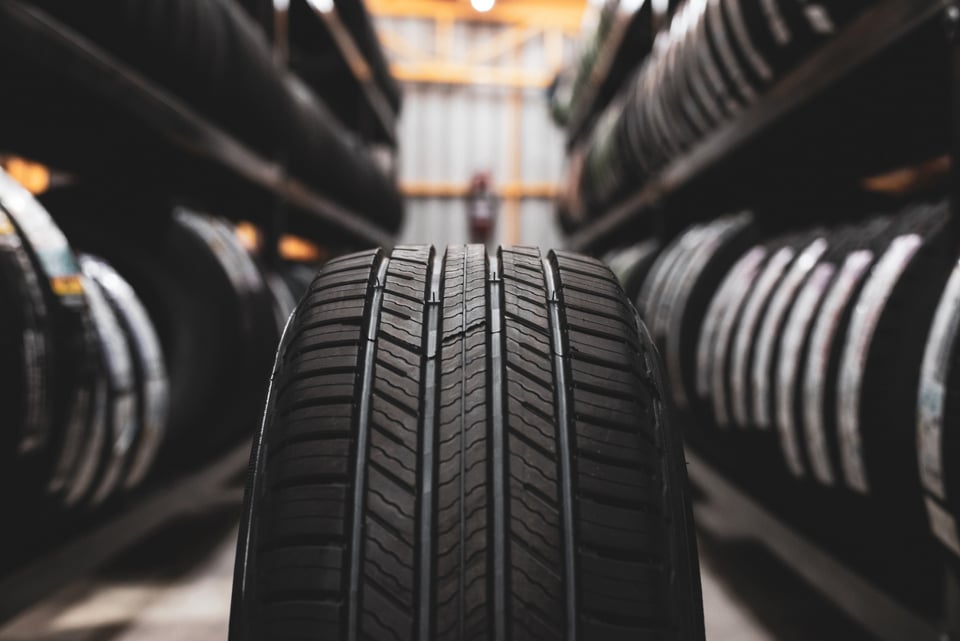
New research has revealed exactly how much drivers are losing, in both money and safety margin, by running their tyres at the wrong pressure. Testing carried out by What Car? and reported by Fleet News shows that under-inflation is not a minor inconvenience. It is a measurable drain on fuel economy and a serious threat to stopping distance and handling.
What Car? tested three identical new tyres, each inflated to a different pressure, to measure rolling resistance, the friction a tyre generates as it rolls along the road. One tyre was set to the recommended 36psi (2.5 bar), the second to 22psi (1.5 bar), and the third to 51psi (3.5 bar).
The under-inflated tyre produced 4.5% more rolling resistance than the correctly inflated tyre (8.48kg/t against 6.67kg/t). Fitted across an Audi A3 1.5 petrol, that translates to an extra £4.50 of fuel for every 100 miles driven. Over a typical year of 10,000 miles, that works out to an additional £450 in fuel costs.
The over-inflated tyre fared better, with rolling resistance only 1.5% higher than the correctly inflated tyre, a modest impact on running costs by comparison.
The financial cost is only part of the story. What Car?’s track testing, again using an Audi A3 1.5 petrol, found that a car fitted with all four tyres under-inflated to 22psi needed 1.3 metres more to stop from 50mph than the same car on correctly inflated tyres. Over that extra distance, the difference between stopping in time and colliding with a vehicle or pedestrian ahead can come down to inches.
The under-inflated tyres also lost grip on a wet surface 5mph sooner than correctly inflated tyres, and handling suffered as a result. The test car took a full second longer to complete a lap of the wet handling circuit, and 1.8 seconds longer on the dry handling circuit, because the driver had to slow down to compensate for reduced grip.
The most striking result came from a test designed to replicate a slow puncture rather than a fully under-inflated set. With only the rear nearside tyre deflated to 22psi, the imbalance was severe enough that the car skidded violently on the wet track and was pushed off the tarmac onto the grass, before the driver could complete a lap. It is a pointed reminder that a single soft tyre, easily missed on a quick visual check, can be enough to unsettle a car in an emergency manoeuvre.
The pressure tests were run alongside a wider tyre trial, pitting five brands against each other across track and lab tests. The Continental PremiumContact 7 came out on top overall, while the Triangle EffexSport TH202 scored lowest. The Michelin Primacy 5 was singled out for the best fuel economy. According to What Car?, the gap between the best and worst tyres in the main test was up to three metres of extra stopping distance, on top of whatever penalty comes from incorrect pressure.
The scale of the issue extends well beyond this test. What Car? notes that around one in five drivers never check their own tyre pressures, relying instead on garages or the annual MOT to catch problems, and that more than half of cars on UK roads are currently running on under-inflated tyres.
Separate research from TyreSafe and the AA, covering more than 22,000 UK drivers surveyed in 2025, found a similar gap between confidence and action: 96% of drivers said they knew how to check their tyre pressure, yet only 30% had actually done so in the previous week. The same survey found that 61% of drivers did not know the maximum fine for an illegal tyre is £2,500 per tyre, and 45% were unaware that each illegal tyre also carries three penalty points, meaning four defective tyres could result in a driving ban.
DVSA figures reinforce the trend. Tyre defects contributed to 2,152,849 MOT failures in 2023-24, up from just over two million the year before and rising steadily since 2019-20. More than a third of those failures had already been flagged as advisories at a previous MOT, pointing to a pattern of known issues going unaddressed. Tread depth below the legal limit remains the single most commonly recorded fault of any kind at MOT failure, and brakes and tyres together account for 88% of the defects serious enough to be marked as “dangerous.”
Checking tyre pressure takes a few minutes at a petrol station or with a home pump gauge, and is worth doing monthly rather than leaving it to the next service or MOT. Correct pressures for a specific car are usually listed on a sticker inside the driver’s door frame or in the handbook, and checks should be done when tyres are cold for an accurate reading.
“It’s good to know that you’ll save money on fuel if your car’s tyres aren’t under-inflated, but it’s the safety implications of driving with too little air in them that make the most compelling argument for checking tyre pressures regularly.
“Our main tyre test also highlights the significant difference in the handling and braking abilities of different tyres. Poorer performing tyres can take up to three metres longer to stop than the best tyres, and that could be the difference between having a near miss or hitting another vehicle in an emergency situation.”
— Claire Evans, What Car? Consumer Editor
Stay Ahead of Compliance Changes
As always, Lloyd Morgan Group is here to support you. If you have any questions about staying compliant or want to review your current systems and processes, please contact us.
Sources
What Car?, “Under-inflated tyres could cost you £450 a year”, whatcar.com
Fleet News, “Fleets warned of safety and cost impact of incorrectly inflated tyres”, fleetnews.co.uk
TyreSafe and the AA, tyre safety awareness research 2025, tyresafe.org
RAC Media, “Brakes and tyres overwhelmingly cause most ‘dangerous’ MOT failures”, media.rac.co.uk








Email us at:
[email protected]
Find us at:
Lloyd Morgan Group Ltd
Phoenix House,
Hemlock Park,
Hyssop Close,
Cannock.
WS11 7GA