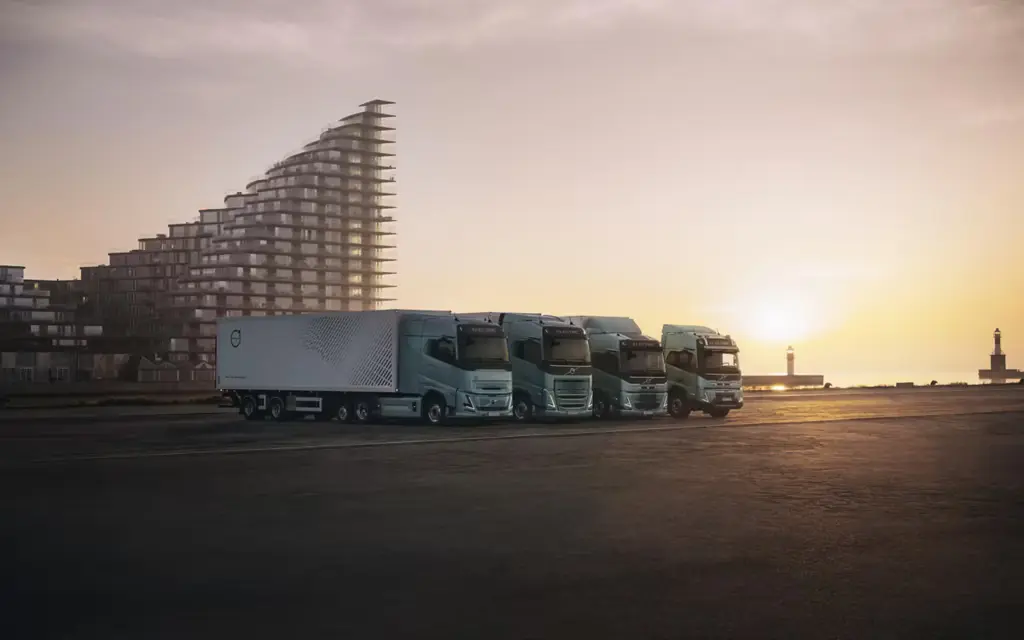
For years, range has been the sticking point that kept electric trucks out of serious long-haul conversation. That argument has become significantly harder to make. Volvo Trucks has unveiled the FH Aero Electric, a heavy-duty tractor unit capable of travelling up to 700km on a single charge, alongside a refreshed generation of FH, FM and FMX Electric models offering up to 470km. All are set to roll out to markets from 2026.
This is not a prototype or a concept. These are production-bound trucks designed for the kind of daily workloads that UK long-haul operators actually run.
The extended range of the FH Aero Electric comes from a fundamental rethink of how the drivetrain is packaged. Rather than mounting motors and transmission components separately, Volvo has developed a compact e-axle that integrates twin electric motors and a six-speed gearbox directly into the rear axle. The space this frees up on the chassis is used for additional battery capacity, giving the truck more usable energy without increasing its footprint.
The configuration is a 6×2, with a tag axle managing the additional battery weight and protecting payload capacity in the process. The result is a truck that produces up to 460 kW (623 hp), carries up to 28 tonnes of payload and operates at up to 44 tonnes gross combination weight.
Charging is equally serious. The FH Aero Electric supports the Megawatt Charging System (MCS) standard, reaching 20% to 80% in approximately 50 minutes at 700 kW. For operators using the 350 kW CCS standard, the same charge window takes around 85 minutes. Volvo has positioned the truck specifically for hub-to-hub routes and two-shift operations, where charging can align with mandatory driver rest periods rather than adding to journey time.
The updated FH, FM and FMX Electric models complete the announcement. These bring improvements across flexibility, productivity and driver comfort, with the FMX capable of operating at up to 65 tonnes GCW depending on configuration, and all models supporting 350 kW CCS charging with a 20% to 80% recharge in around 65 minutes.
As Volvo’s president Roger Alm put it, it has never been easier to replace diesel trucks with electric ones.
Volvo is not operating in isolation. The Mercedes-Benz eActros 600, widely considered the first long-haul electric truck to enter series production in Europe, has already demonstrated real-world ranges beyond 500km under full load, with MCS charging capable of reaching 80% in roughly 30 minutes. Scania has confirmed MCS-compatible electric trucks for early 2026, targeting similar charge times. MAN’s eTGX rounds out the top tier of European contenders, also offering up to 500km of range.
The 700km barrier, long treated as the threshold at which battery-electric trucks could genuinely compete with diesel for long-distance work, is now clearly within reach. With multiple manufacturers converging on this territory simultaneously, operators who have been holding back for the technology to mature are running out of reasons to wait.
The arrival of capable electric HGVs in mainstream long-haul fleets brings a separate challenge into sharp focus: the shortage of qualified technicians to maintain them.
According to the latest data from the Institute of the Motor Industry (IMI), just 26% of UK automotive technicians were qualified to work on electric vehicles by the end of Q3 2025. The pace of training is also slowing, with the number of technicians gaining an EV qualification in Q3 2025 falling by 13% compared to Q1. The IMI has warned the shortfall could reach 16,000 qualified technicians by 2035, with skills heavily concentrated in franchise dealer networks rather than the independent workshops and fleet maintenance operations that will carry much of the servicing burden.
For HGV and PSV operators, the duty of care obligation under the Electricity at Work Regulations 1989 is clear. High-voltage systems on electric commercial vehicles cannot be approached with standard mechanical knowledge, and employers are responsible for ensuring that any staff working on or around those systems are appropriately qualified.
Lloyd Morgan Group offers a full pathway of IMI-accredited electric and hybrid vehicle training for commercial workshop teams. The Level 1 Award in Electric/Hybrid Vehicle Awareness is the right starting point for anyone working around electrified vehicles without directly servicing the high-voltage systems, covering hazard recognition, charging safety and safe workshop practices. For technicians working directly on HGV and PSV high-voltage systems, the Level 3 Award in Heavy Electric/Hybrid Vehicle System Repair and Replacement covers system architecture, isolation procedures, battery systems, diagnostic testing and the safe repair and replacement of high-voltage components.
You can view the full range on our Electric and Hybrid Vehicle Training page, or call us on 01543 897505 to discuss your team’s requirements.
The trucks are on their way. The workshops that are ready to maintain them will have a clear advantage.
Range figures are subject to conditions including weather, wind resistance, vehicle weight and driver performance.









Email us at:
[email protected]
Find us at:
Lloyd Morgan Group Ltd
Phoenix House,
Hemlock Park,
Hyssop Close,
Cannock.
WS11 7GA